Open Supervised Device Protocol - OSDP
Real World Interfacing using OSDP-1000
Control and monitor security and access control devices using the OSDP-1000.
Even if not destined for the tradional security or access control application, writing software to control and monitor remote devices is simplified by use of the OSDP standard. Many companies provide a wide variety of addressable devices designed to monitor and control real-world sensors and actuators. Unfortunately, these are typically done using simple yet proprietary protocols. In other words, everyone is doing it 'their way'. OSDP provides a starting point in an industry-wide effort to offer interoperability amongst multiple devices from multiple manufacturers.
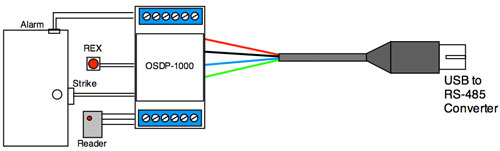
Capability Report - One of the most useful features of OSDP is the Capabilities Report returned by the device in response to a request by the host application. This allows software to be written for many diverse modules that may appear on the network. Details such as what type of card reader formats are available, how many colrs will the LED support, how flexible are the outputs, etc.
Timed Functions - Due to the nature of Poll / Response protocols, rapid control of remote devices can be tricky due to latency in the network. OSDP provides a means of sending a command to 'blink the LED 1/2 second on, 3/4 second off, for 5 seconds'. This greatly enhances the user experience while reducing the burden on the controlling application to continuously change the state of the output. Likewise, pulsing a relay on for one second is a single command.
126 Polling IDs - Up to 126 devices can be addressed on a single pair of wires. There is no physical limit as to how many channels can be processed. Any limitations would be imposed by software processing time. The addresses are set via DIP switch or configuration command depending on the manufacturer. It is suggested that the address of 01 be reserved for unconfigured (out of the box) devices. If a new device is introduced on a network (one at a time), the host application can command that unit to change its address to any in the range of 2 to 126. There is also a reserved broadcast ID of 00 in which all devices will accept the command and respond.